Pay Off Debt or Invest? Maya's $750 at 2026 Rates
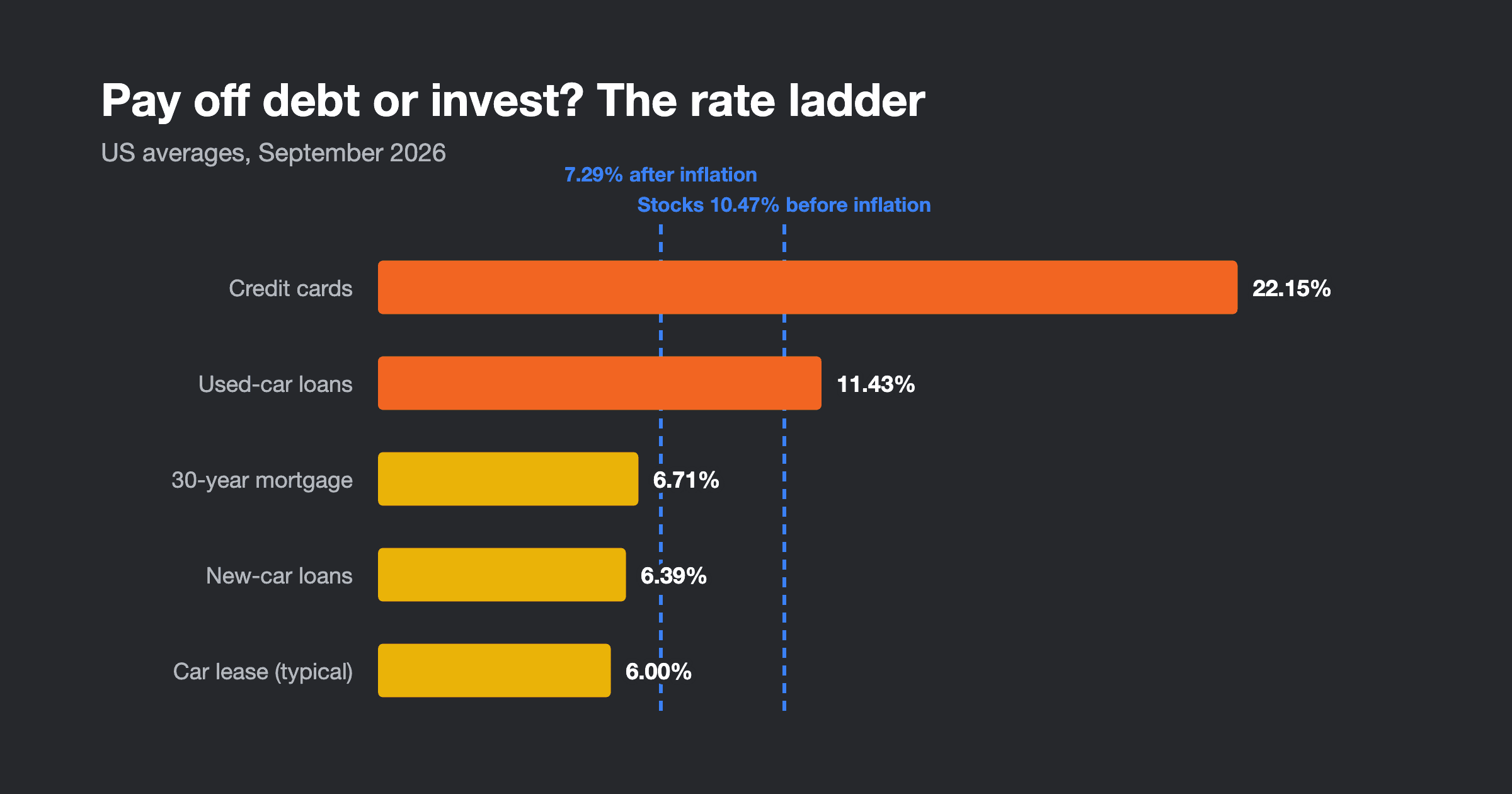
Maya has $750 a month. Her card charges 22.15%. Her car loan charges 6.39%. Her mortgage charges 6.71%. The stock market has paid 10.47% a year since 1926, before inflation.
Should the $750 pay debt or buy index funds? Five charts decide it. Then a calculator decides yours.
Every debt payment is an investment
Pay $100 on a 22% card and you are $22 richer next year, guaranteed. That's an investment with a 22% return that no fund can match, and the tax office can't touch it.
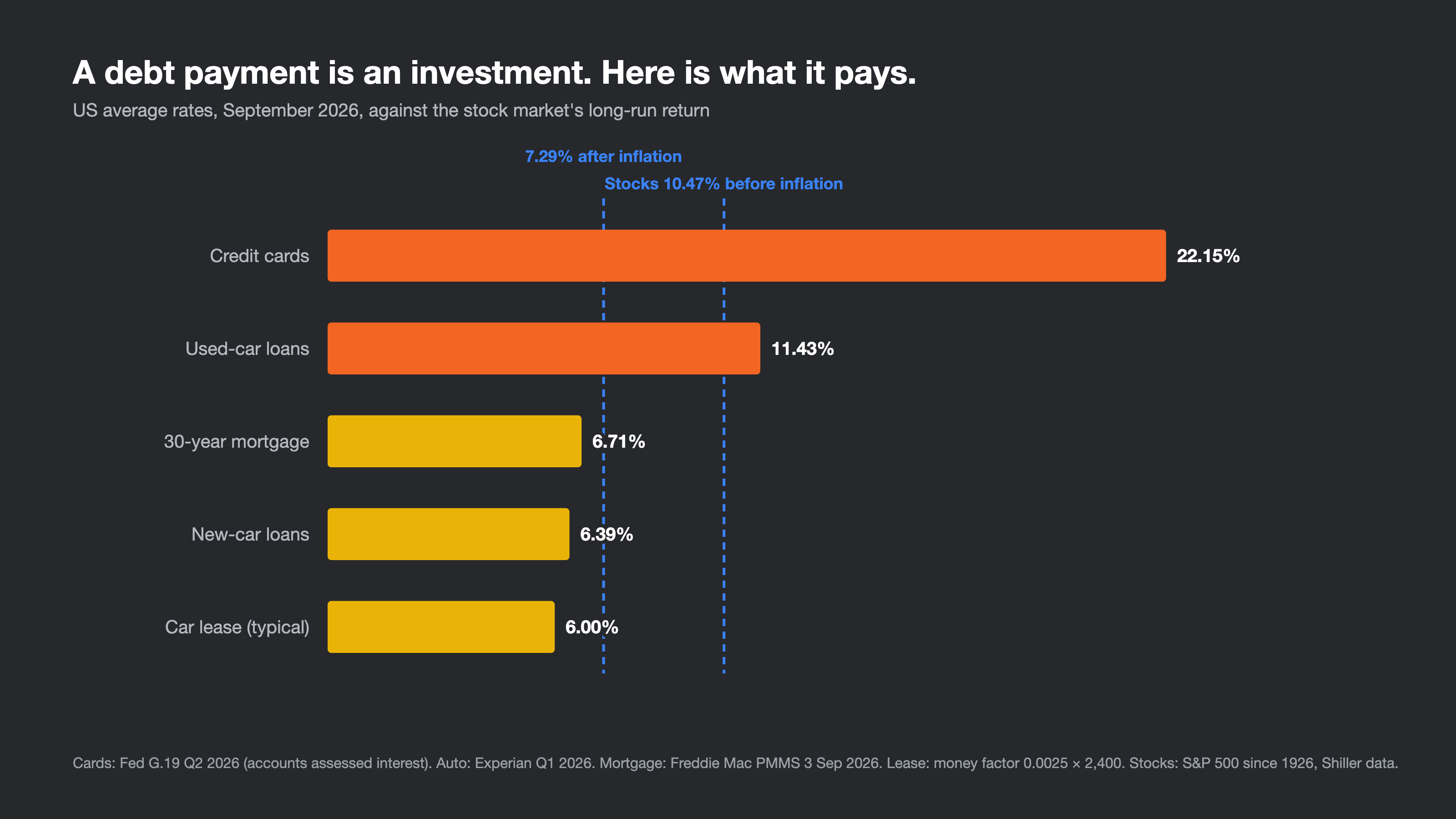
So the whole question is one comparison: the debt's rate against the return you expect from investing. Above the line, pay. Below it, invest. Near it, the answer is about sleep.
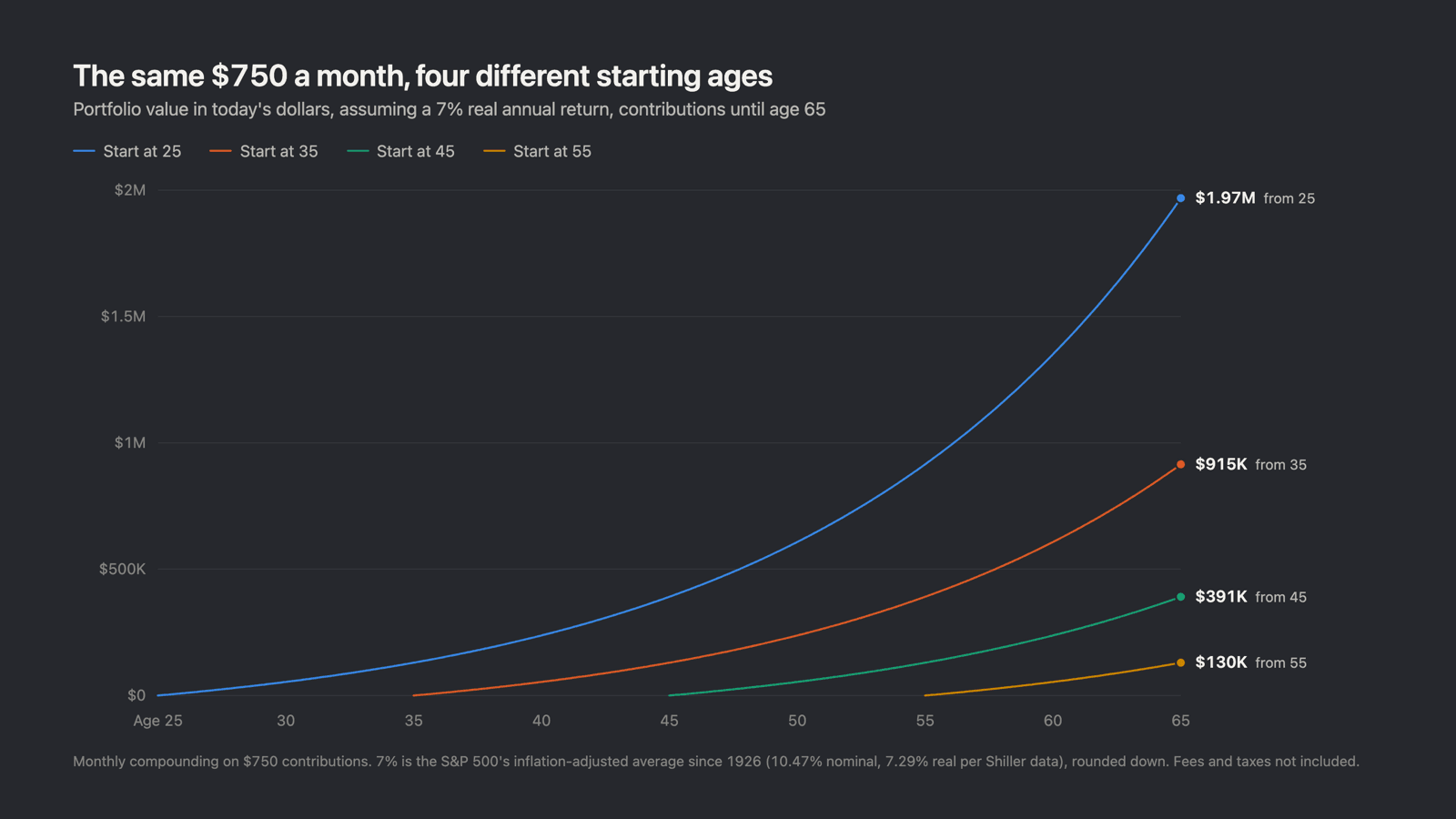
One correction to our last post. There we used 7% because it was after inflation. Debt rates are before inflation, so here the fair comparison is 10% for stocks, with 7% as the cautious case.
The card: not close
Maya's card holds $6,500 at 22.15%, the Federal Reserve's average for accounts that carry a balance. The minimum payment is $185 and drops as the balance does.
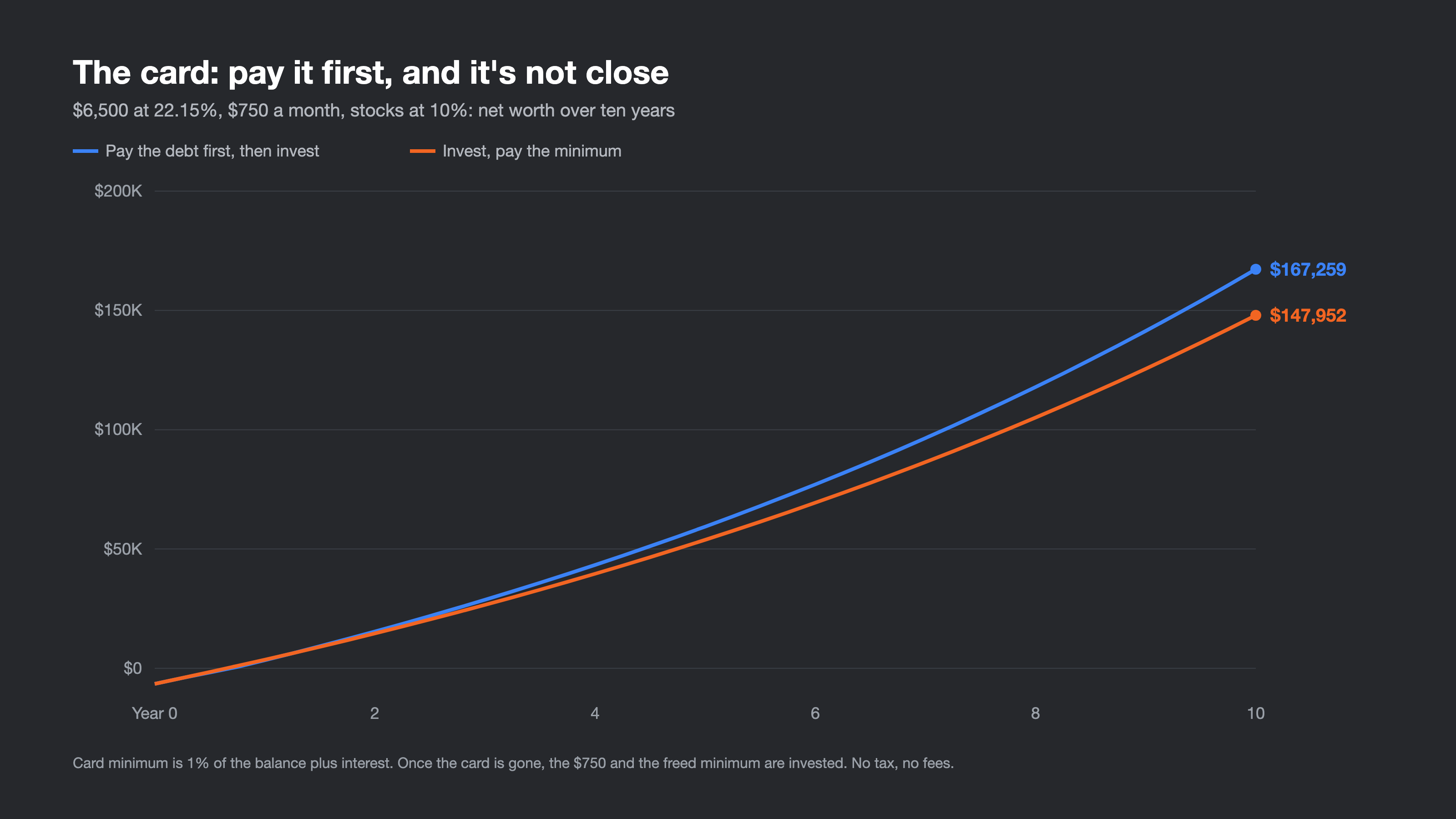
| $6,500 card, ten years, stocks at 10% | Pay it first | Invest, pay minimum |
|---|---|---|
| Card gone | Month 9 | Not within 10 years |
| Interest paid | $551 | $8,406 |
| Net worth at year 10 | $167,259 | $147,952 |
Paying the card first is worth $19,307 over ten years, and the win is guaranteed. At a cautious 7% return it's $18,553. On minimums alone the card takes 21 years to clear and costs $10,927 in interest.
Nine months. Then the $750 goes to the market with a clear conscience.
The car loan: a coin flip
The car is $30,000 at 6.39% over 60 months, the average new-car rate. Payment: $585.
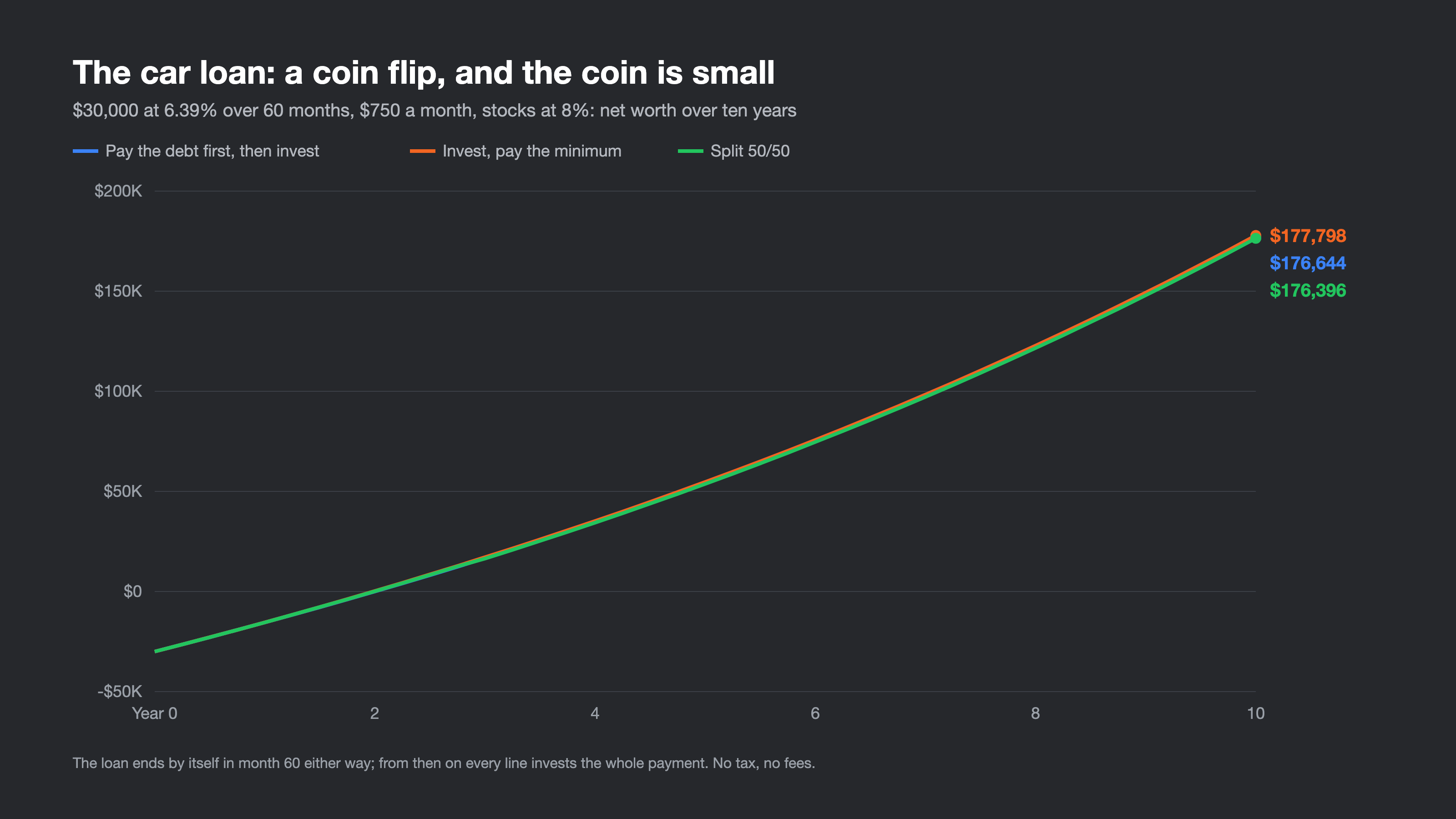
| $30,000 car loan, ten years, stocks at 8% | Pay it first | Invest, pay minimum | Split |
|---|---|---|---|
| Loan gone | Month 24 | Month 60 | Month 35 |
| Interest paid | $2,037 | $5,126 | $2,899 |
| Net worth at year 10 | $176,644 | $177,798 | $176,396 |
The gap is $1,154 on a $30,000 loan over ten years. At 10% it's $3,172 for investing; at 7% it's $319. That's the size of the coin.
The tie breaks on risk. The 6.39% is certain; the 8% is an average that includes years like 2008. If a paid-off car lets you sleep, pay it. If not, invest and don't look back.
The lease: the debt you can't pay off
A lease has no principal to prepay. Its rate hides in the "money factor", which you turn into an APR by multiplying by 2,400.
| Money factor | APR |
|---|---|
| 0.0020 | 4.8% |
| 0.0025 | 6.0% |
| 0.0030 | 7.2% |
| 0.0035 | 8.4% |
| 0.0040 | 9.6% |
The average lease payment is $606 a month against $762 for a new-car loan. The loan ends. The lease rolls into the next lease. $606 a month invested at 8% instead is $109,155 in ten years and $344,813 in twenty.
The lease question isn't pay-or-invest. It's whether to have the payment at all.
The mortgage: one number you can't know
Maya's mortgage is $350,000 at 6.71%, this month's Freddie Mac average. Payment: $2,261. An extra $750 a month clears it in month 189, fifteen years and nine months, and saves $247,002 in interest.
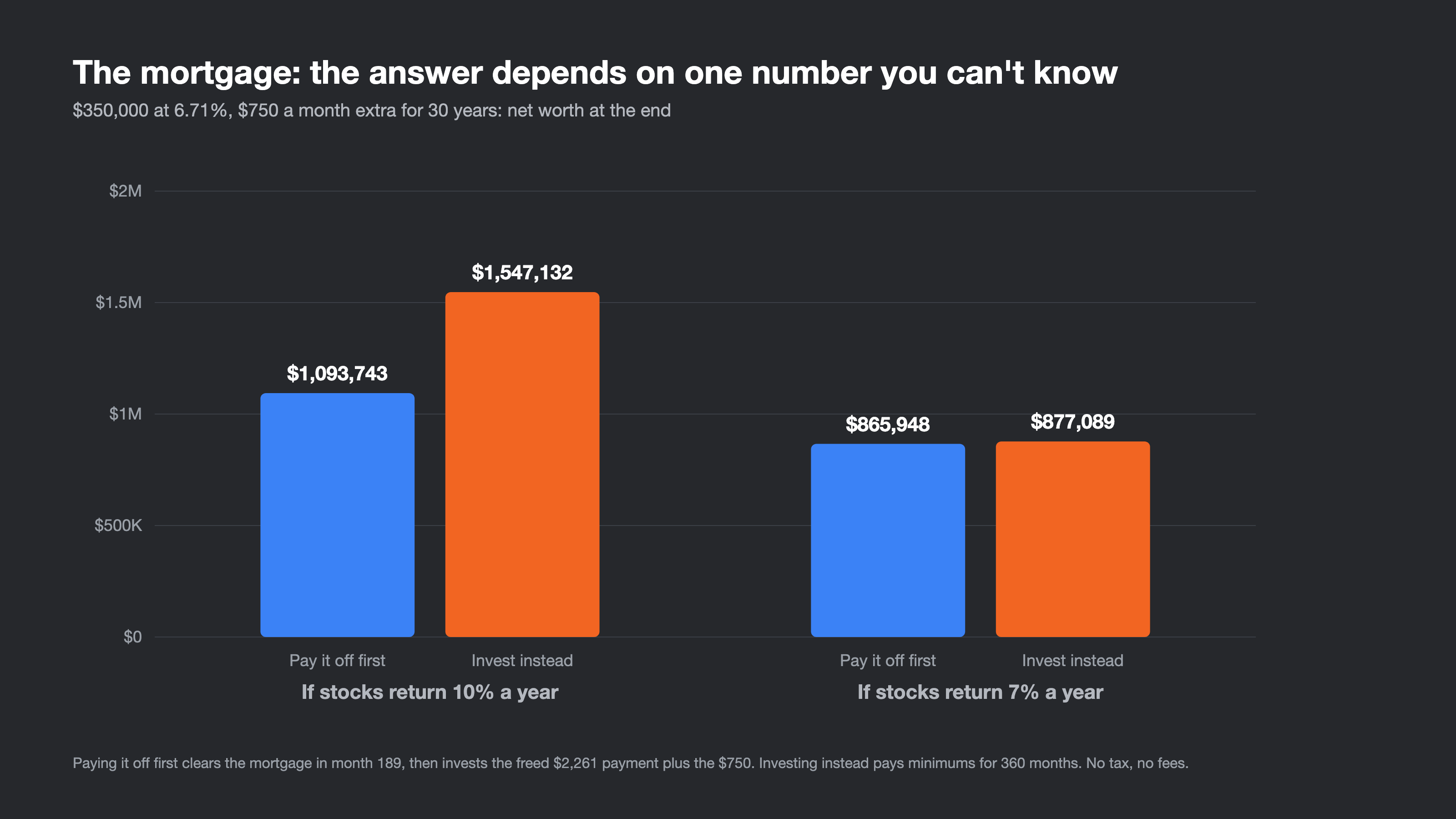
| $350,000 mortgage, thirty years | Pay it first | Invest, pay minimum |
|---|---|---|
| Mortgage gone | Month 189 | Month 360 |
| Interest paid | $216,884 | $463,886 |
| Net worth at year 30, stocks at 10% | $1,093,743 | $1,547,132 |
| Net worth at year 30, stocks at 7% | $865,948 | $877,089 |
At the market's historical 10%, investing wins by $453,389. At 7% the two are $11,141 apart on nearly a million dollars: a dead heat. Below 6.71% the mortgage wins.
Nobody knows which return the next thirty years will pay. So the honest answer is the middle one: split the $750, or pay the mortgage if a paid-off house is worth more to you than a bigger number on a screen. Both are fine. Only the card was not close.
The whole decision on one grid
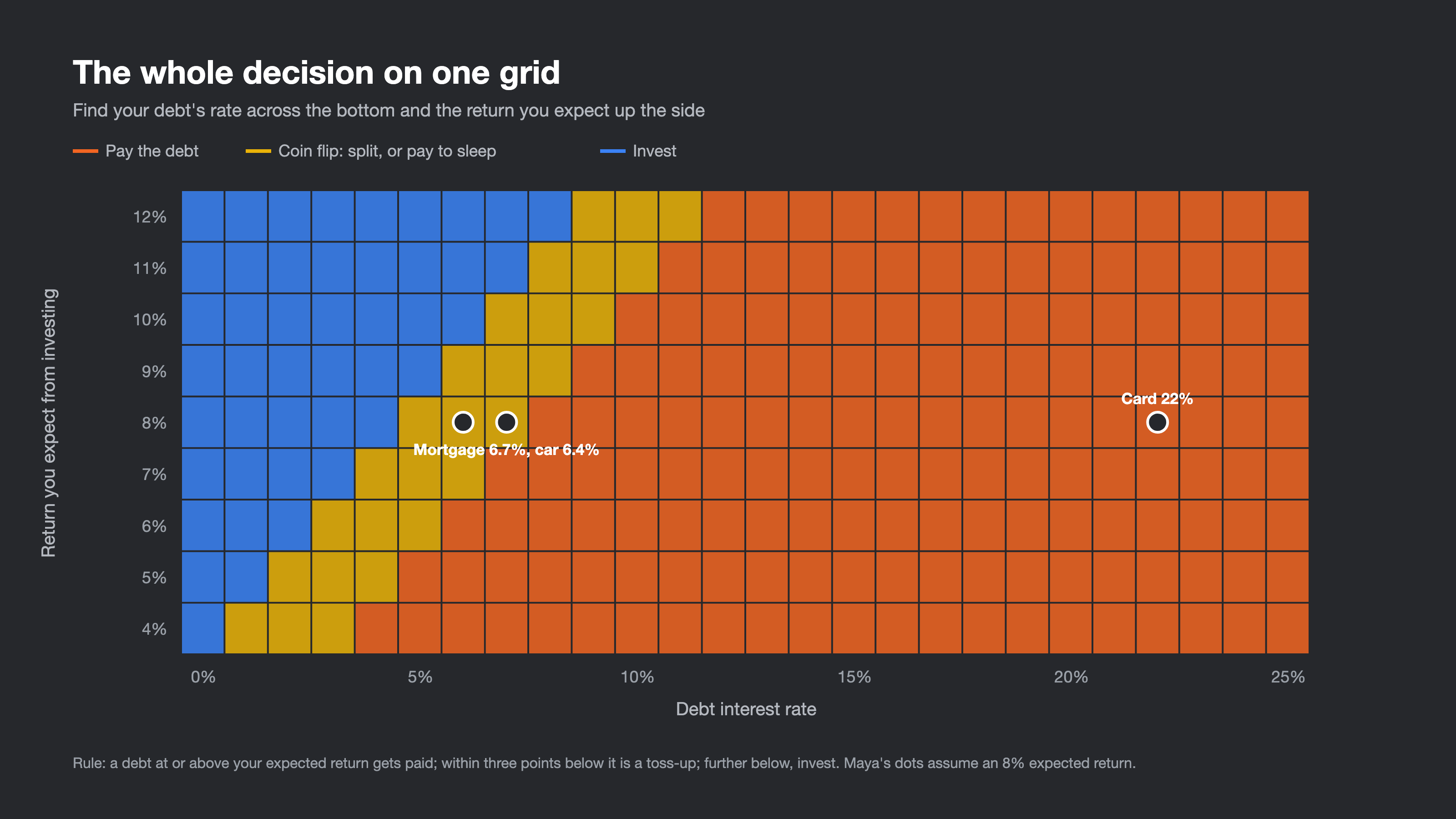
Find your debt's rate along the bottom and the return you expect up the side. Orange, pay. Yellow, split or pay to sleep. Blue, invest.
The order
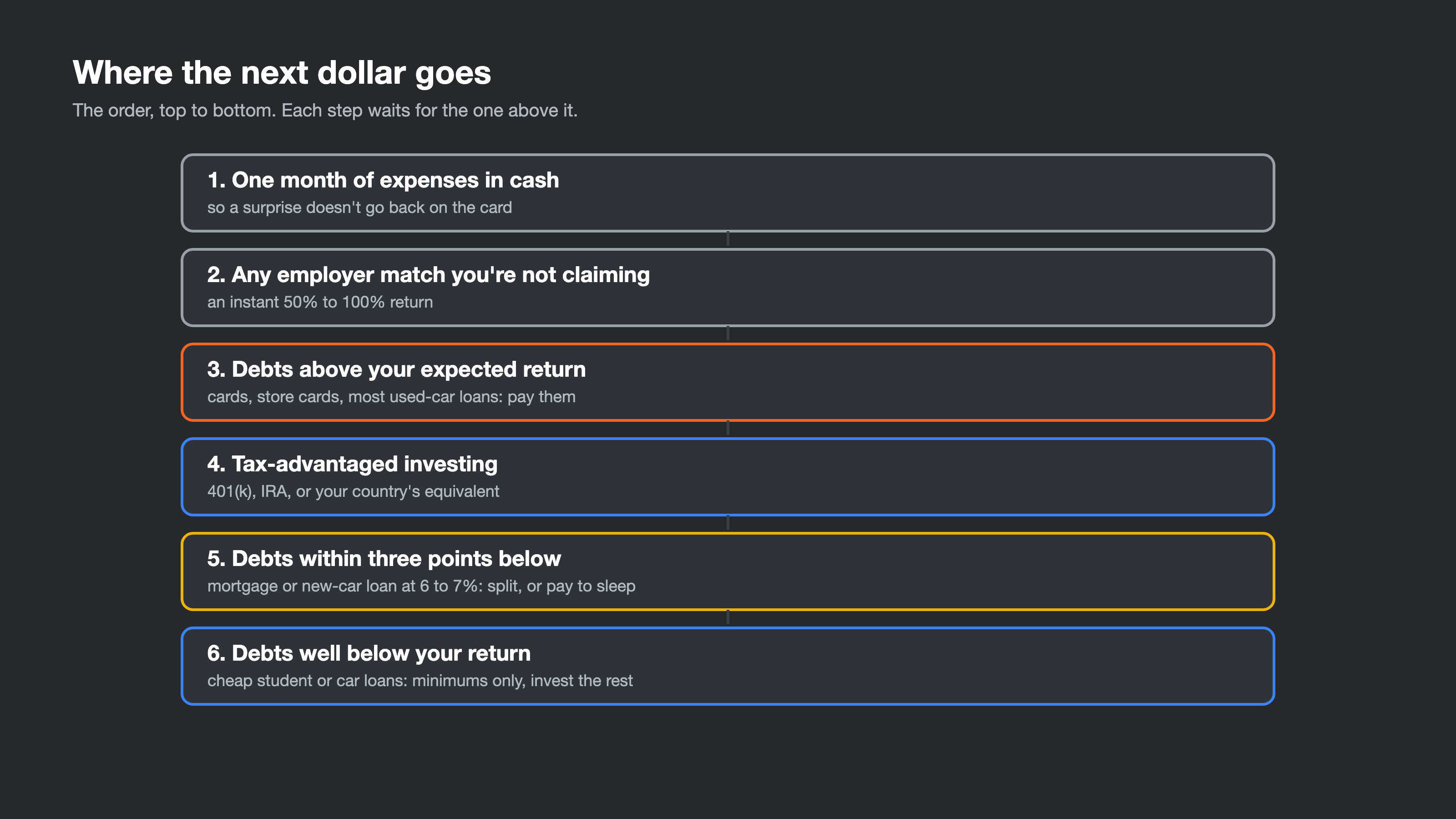
Two steps come before any of the charts. One month of expenses in cash, so a surprise lands there and not on the card. And any employer match you're not claiming, which is an instant 50% to 100% return that beats every bar on the ladder.
Your numbers aren't Maya's
Your plan
Put the $750 on Credit card first. It pays 22.15% guaranteed; the market's 8% is a hope.
- Send $750 a month to Credit card (22.15%). Gone in month 9.
- Invest $935 a month at the 8% you expect.
Net worth over 10 years
| Pay debt firstRecommended | Invest, pay minimums | Split 50/50 | |
|---|---|---|---|
| Net worth at the end | $151,973 | $133,147 | $150,196 |
| Interest paid | $551 | $8,406 | $989 |
| Debt-free | Month 9 | Not within horizon | Month 16 |
Email me this plan
The verdict, the steps, and a link that reopens these exact numbers.
Where Maya ends up
Card first, gone in nine months. Then the $750 and the freed $185 go half to the mortgage and half to an index fund inside a retirement account, and the car loan runs its course.
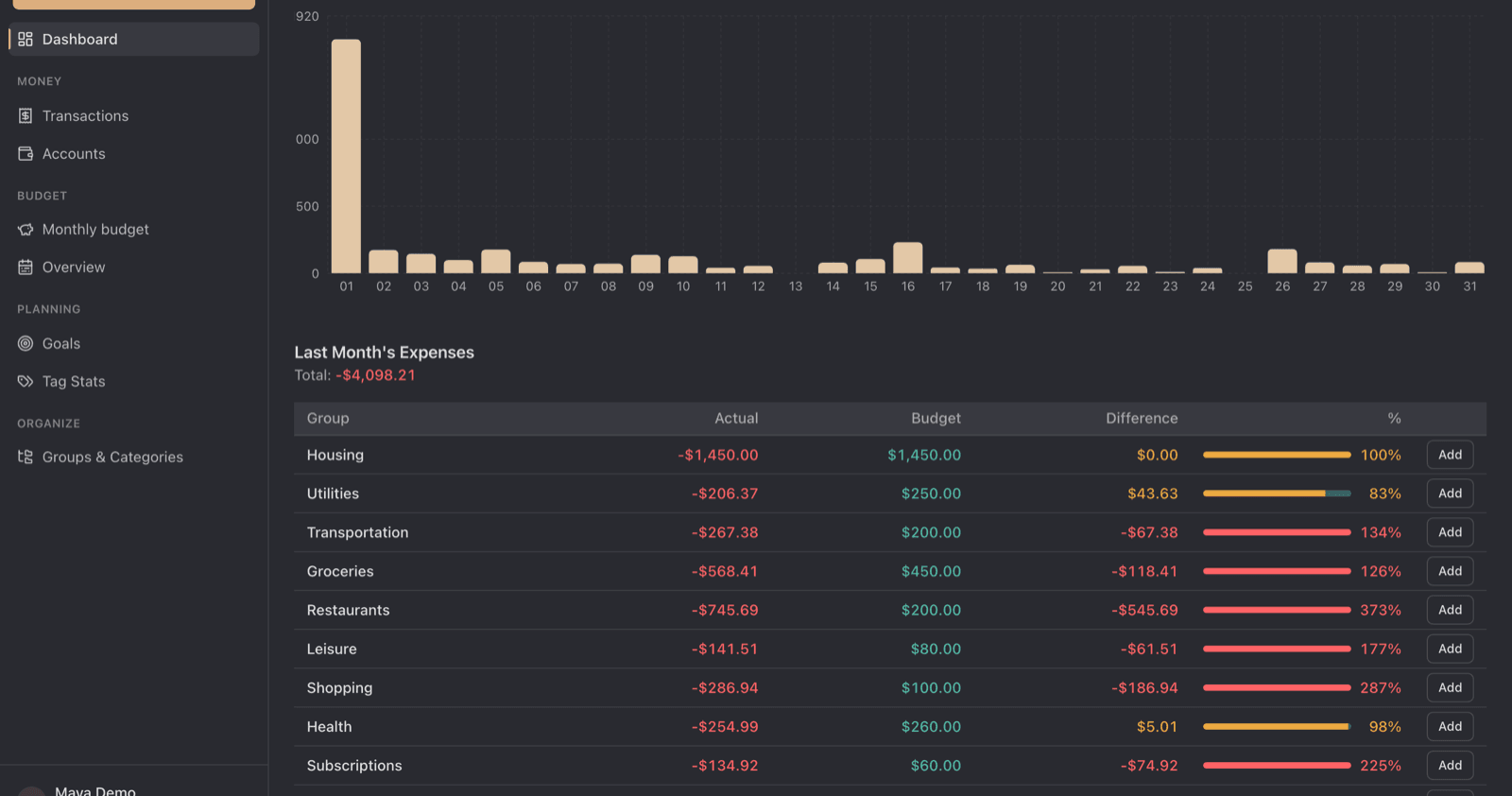
Paying a debt down is a goal like any other. Pikaflow tracks it next to the spending that funds it, free for a month with no card. Start with the leaks, then come back to the grid.
Sources
- Federal Reserve, G.19 Consumer Credit, Q2 2026: 22.15% on accounts assessed interest, 20.94% on all accounts: https://www.federalreserve.gov/releases/g19/current/
- Experian, State of the Automotive Finance Market, Q1 2026: 6.39% new, 11.43% used: https://www.experian.com/blogs/ask-experian/auto-loan-rates-financing/
- Freddie Mac, Primary Mortgage Market Survey, September 3, 2026: 6.71%: https://www.freddiemac.com/pmms
- Edmunds and Experian, Q1 2026 average lease and loan payments: https://www.experian.com/blogs/ask-experian/average-car-payment/
- Official Data, S&P 500 returns since 1926 (Shiller data; 10.47% nominal, 7.29% real): https://www.officialdata.org/us/stocks/s-p-500/1926
- Pikaflow, "Compound Interest by Age": /blog/compound-interest-by-age
All scenario figures were computed by us with monthly compounding, no fees and no tax; the calculator above uses the same math. Card minimums are 1% of the balance plus interest. Maya is a demo persona. Nothing here is investment advice.