Compound Interest by Age: Why Ten Years Beats Thirty
Invest $750 a month from age 25 to 35, then stop. At 65 you'll have more than someone who invests $750 a month from 35 to 65 and never misses a month.
Ten years beats thirty. The ten-year investor puts in $90,000 and ends with about $1.05 million. The thirty-year investor puts in $270,000 and ends with about $915,000.
That's the post. The rest is the math, in tables you can check, at whatever age you're reading this.
We didn't pick $750 for roundness. It's what our last post, Where Does My Money Go?, found leaking out of a demo account every month: forgotten subscriptions, delivery markups, coffee, impulse buys, fees. This post asks what happens if that money goes somewhere else.
Compound interest by age: the assumptions first
Every number below assumes one return: 7% a year after inflation.
That's not optimistic. Since 1926 the S&P 500 has returned 10.47% a year with dividends reinvested, or 7.29% after inflation, per the Shiller dataset compiled by Official Data. We rounded down.
Because 7% is already inflation-adjusted, every figure is in today's dollars. $1.97 million means what $1.97 million buys now, not in 2066.
The tables also assume monthly contributions, no fees, and no tax along the way. Fees get their own section. "No tax" means "use a retirement account", which we'll get to.
What $750 a month becomes by 65
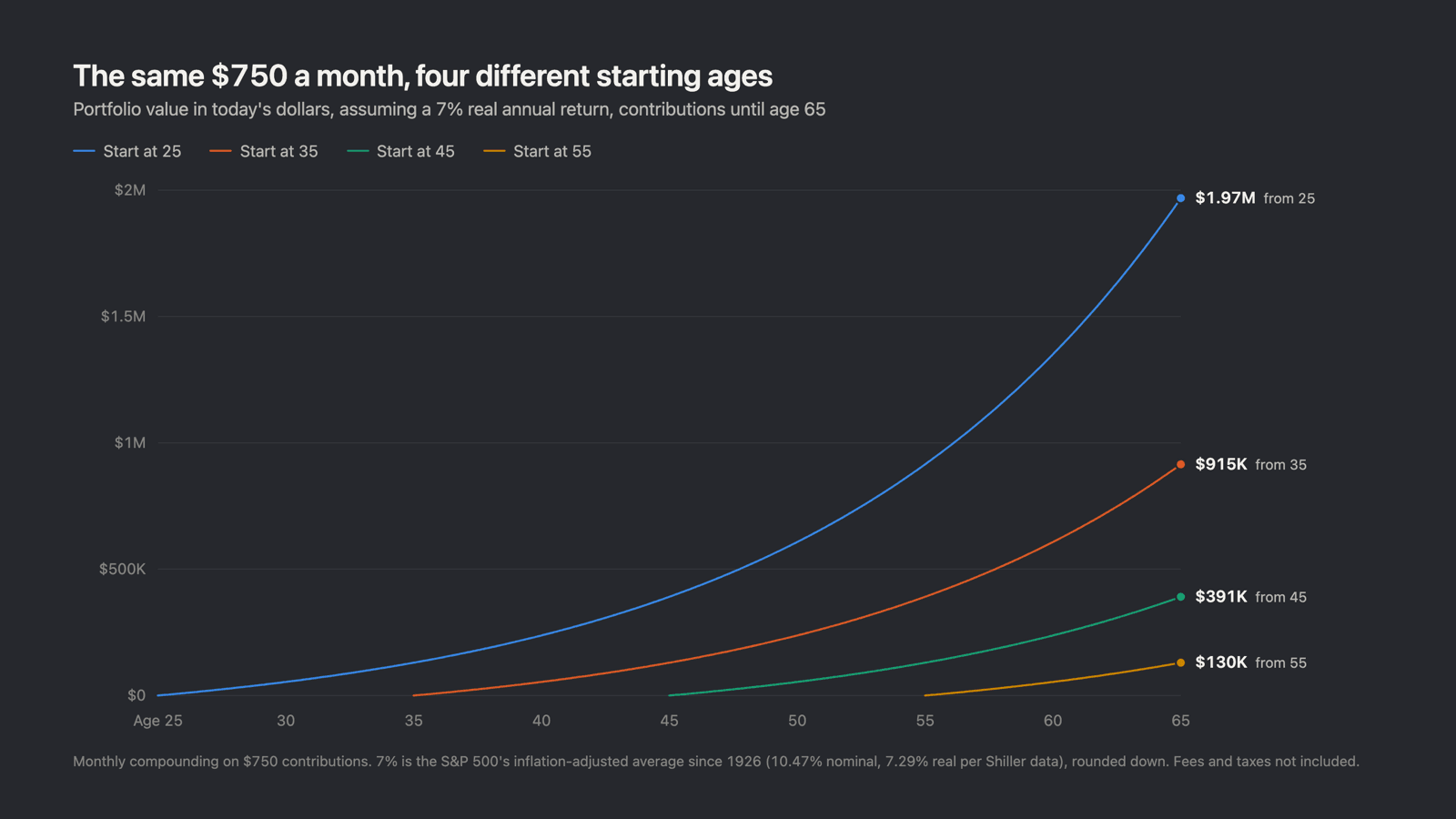
Same monthly amount, four starting ages, held to 65.
| Start age | Years | You put in | Value at 65 | Growth | Multiple |
|---|---|---|---|---|---|
| 25 | 40 | $360,000 | $1,968,610 | $1,608,610 | 5.5x |
| 35 | 30 | $270,000 | $914,978 | $644,978 | 3.4x |
| 45 | 20 | $180,000 | $390,695 | $210,695 | 2.2x |
| 55 | 10 | $90,000 | $129,814 | $39,814 | 1.4x |
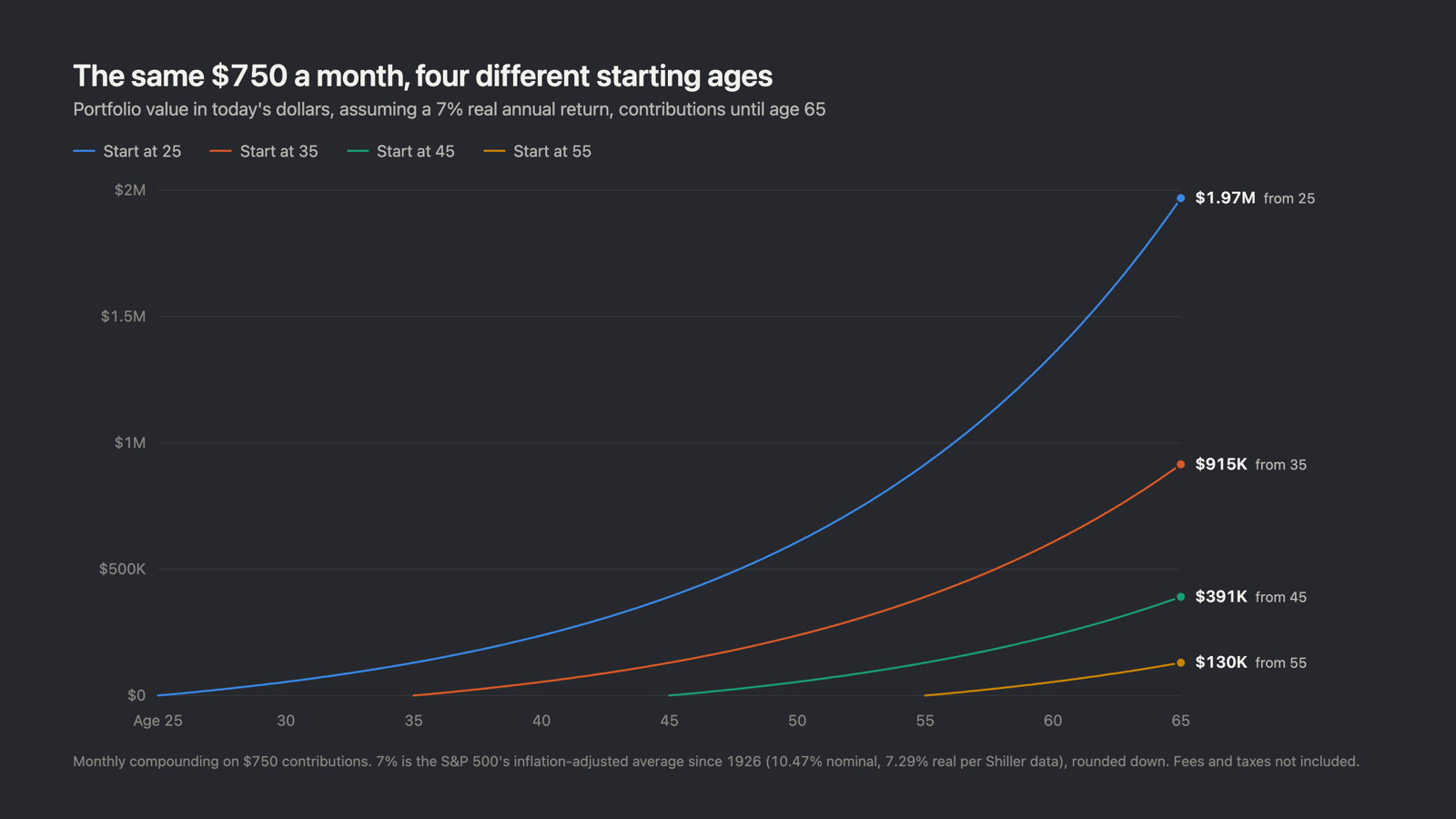
Read the Growth column. The 25-year-old's money earns $1.6 million by itself. The 55-year-old's earns $40,000. Same $750, same 7%. The only variable is the calendar.
Or read the multiples. Start at 25 and every dollar comes back as five and a half. Start at 55 and it comes back as $1.40.
Why the first ten years beat the next thirty
Back to the opening claim, the one nobody believes.
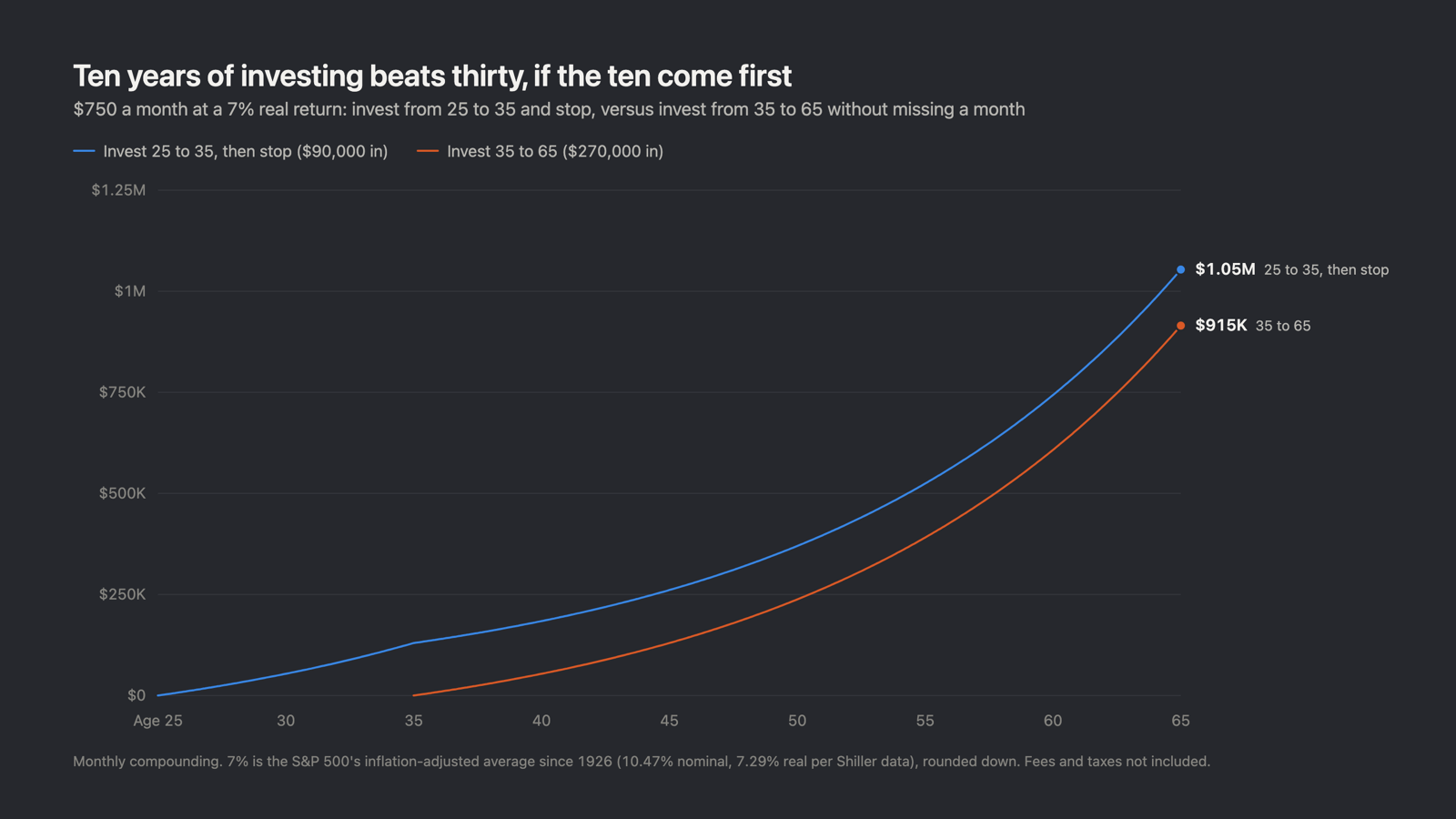
The blue line stops contributing at 35 with $129,814 and then sits for thirty years, doubling about every ten. Three doublings turn $130,000 into just over $1 million.
The orange line starts at 35 with nothing and must build the whole pile from contributions. Its last dollars, invested at 64, barely grow.
That's the rule of 72. Divide 72 by the return and you get the doubling time: at 7%, about ten years. A dollar invested at 25 doubles four times by 65 and becomes $15. Invested at 45, it doubles twice and becomes $4. Invested at 60, it becomes $1.40.
The last five years earn more than the first twenty
Compound growth is back-loaded. It feels slow at the start and absurd at the end.
Here's the 25-year-old's account, every five years.
| Age | You've put in | Account value | Gained in the last 5 years |
|---|---|---|---|
| 30 | $45,000 | $53,695 | $53,695 |
| 35 | $90,000 | $129,814 | $76,119 |
| 40 | $135,000 | $237,722 | $107,908 |
| 45 | $180,000 | $390,695 | $152,973 |
| 50 | $225,000 | $607,554 | $216,859 |
| 55 | $270,000 | $914,978 | $307,424 |
| 60 | $315,000 | $1,350,791 | $435,813 |
| 65 | $360,000 | $1,968,610 | $617,819 |
The first five years add $54,000, nearly all of it your own money. The last five add $618,000, nearly none of it.
This is where people quit. At 30 the account barely beats a mattress, and it's tempting to call the whole thing overrated. The people who call it that at 30 hold $130,000 at 55 instead of $915,000.
What it costs to wait
Say you're not 25 and you still want the 25-year-old's $1.97 million at 65. Here's the monthly amount that gets there from each start, at the same 7%.
| Start age | Monthly amount needed | Compared to $750 |
|---|---|---|
| 25 | $750 | 1x |
| 35 | $1,614 | 2.2x |
| 45 | $3,779 | 5x |
| 55 | $11,374 | 15x |
Waiting from 25 to 35 doubles the price. Waiting to 45 multiplies it by five. At 55 the number stops being a savings rate and becomes a salary.
That's no argument for despair at 45. It's an argument against waiting one more year at any age, because every year raises the price.
Where people your age actually are
The tables above are what could happen. Here's what has, from two sources that count real accounts.
The Federal Reserve's Survey of Consumer Finances (2022 data, released 2023) gives the median retirement balance for households that have an account:
| Household age | Median balance | Average balance |
|---|---|---|
| Under 35 | $18,880 | $49,130 |
| 35 to 44 | $45,000 | $141,520 |
| 45 to 54 | $115,000 | $313,220 |
| 55 to 64 | $185,000 | $537,560 |
Vanguard's How America Saves 2025 reports the median 401(k) balance in the plans it runs, at the end of 2024: $16,255 for ages 25 to 34, $39,958 for 35 to 44, $67,796 for 45 to 54, and $95,642 for 55 to 64.
Read the medians. A few large accounts drag the average up; the median is the person in the middle. And the Fed counts only households that have an account at all. Only about half of households headed by someone under 35 do.
Now line the tables up. A 35-year-old who started $750 a month at 25 holds $129,814, 2.9 times the median 35-to-44 household. A 45-year-old who started at 25 holds $390,695 against a median of $115,000. Neither is a genius investor. Both were early.
Each leak, reinvested
The $750 came from specific habits. Here's what three of them become on their own at 7%.
| Leak | Monthly | From 25 | From 35 | From 45 |
|---|---|---|---|---|
| Forgotten subscriptions | $77 | $202,111 | $93,938 | $40,111 |
| Coffee | $105 | $275,605 | $128,097 | $54,697 |
| Delivery apps | $255 | $669,327 | $311,093 | $132,836 |
Yes, this is the latte argument. It's annoying because it's right: 17 coffees a month, invested from 25, is a $275,000 decision. Nobody makes that decision. They make 17 six-dollar ones.
Delivery is the one to stare at. From 25, $669,000 is the price of not walking to the restaurant.
If you're 45 or 55, read this part
The 25-year-old's table is the one everyone shares, and it makes the 45-year-old close the tab.
Don't. Three things still hold at 45.
$750 a month from 45 becomes $390,695 at 65, 3.4 times the median 45-to-54 household's balance today. That's far ahead of the middle, not behind it.
Compounding doesn't stop at 65. Money you don't need at 65 keeps doubling every ten years. The 55-year-old's $130,000 becomes about $255,000 at 75 if left alone.
And the cost-of-waiting table bites hardest here. At 45, one more year of delay costs more in dollars than it did at 25. The best age to start was 25. The second best is this month.
The two things that quietly eat the table
Fees first. Every table assumes 7%. Pay a 1% annual fee, which many actively managed funds and advisors still charge, and your real return is 6%. For the 25-year-old that's $1,493,618 at 65 instead of $1,968,610. One percentage point, forty years, $475,000.
A broad index fund charges a small fraction of that. That's the whole case for index funds in one number.
Taxes second. In a taxable account you pay tax on dividends every year and on gains when you sell. In a retirement account (a 401(k), an IRA, or your country's equivalent) the money compounds untaxed until you withdraw, or in the Roth version, never. The tables assume that kind of account. We're not advisors, but "fill the tax-advantaged account first" is the least controversial sentence in personal finance.
How to find the $750
The tables only matter if the $750 exists. It usually does, and it's usually invisible, which is what the first post was about.
- Log a month. Every purchase, at the counter, ten seconds each. Not to judge it. To see it.
- Tag the leaks: "Forgotten sub", "Delivery", "Impulse", "Fees". At month end, read the tag totals. That's your number. It might be $300 or $900.
- Automate the transfer for the day after payday, into an index fund inside a retirement account. Automatic beats large, because the tables only work if you never skip a month.
- Track it as a goal and check it monthly, not daily. The first five years are slow on purpose.
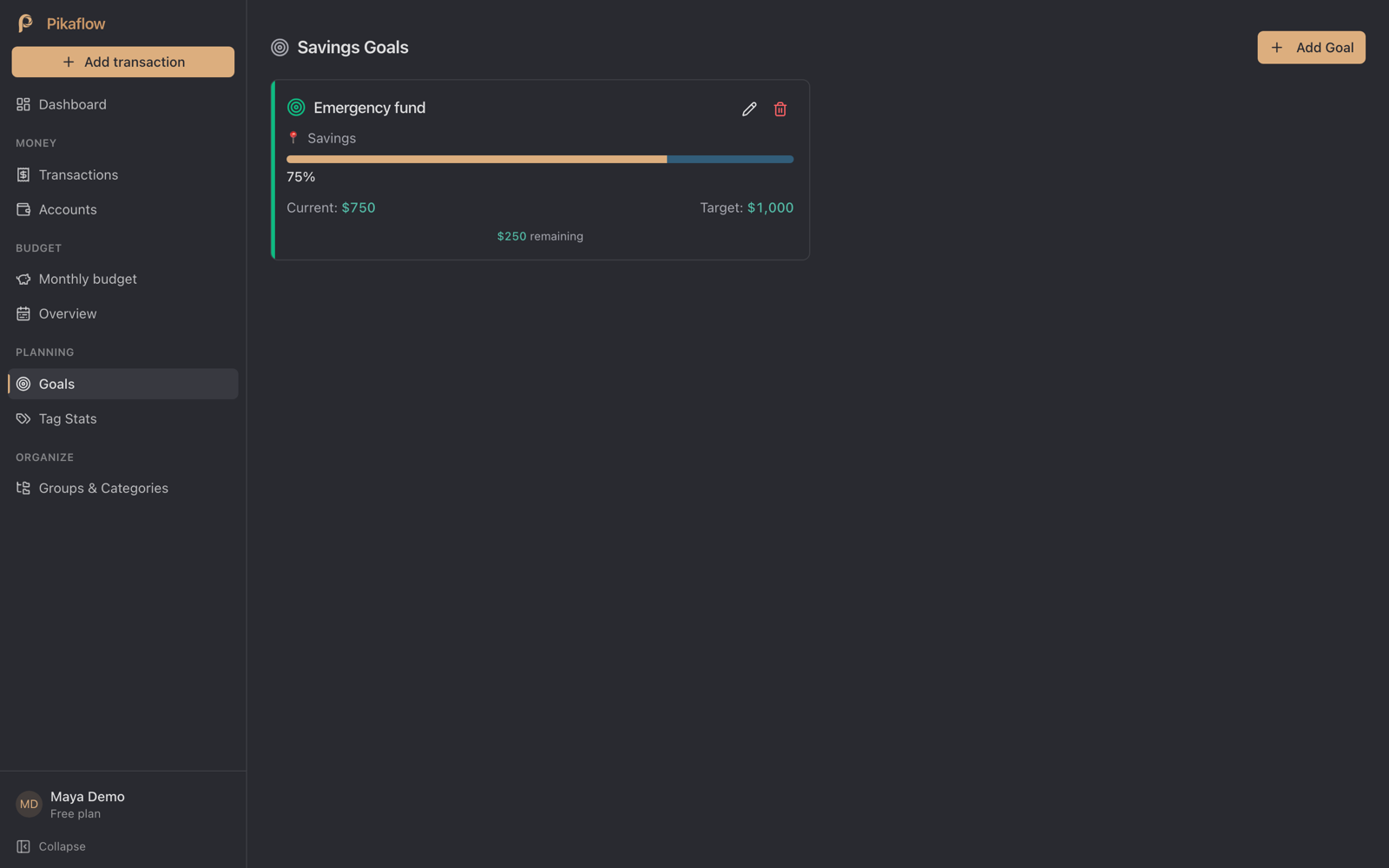
Pikaflow is the logging-and-tagging half of that list. It won't pick your fund, and its projection looks one year ahead, not forty. But it's where the $750 gets found, and it's free for a month with no card. Start with the leaks, then come back to the tables.
Maya, the demo persona from the first post, is 31. If her $750 starts next month, the tables say $1,251,057 at 65. If she reads this again at 41, the same $750 is worth $693,000 less.
She should not wait ten years.
Sources
- Official Data, "S&P 500 Returns since 1926" (Shiller dataset, BLS CPI; 10.47% nominal, 7.29% real): https://www.officialdata.org/us/stocks/s-p-500/1926
- NerdWallet, summary of the Federal Reserve Survey of Consumer Finances 2022 retirement account balances by age (2023 release): https://www.nerdwallet.com/retirement/learn/the-average-retirement-savings-by-age-and-why-you-need-more
- CNBC Select, summary of Vanguard "How America Saves 2025" 401(k) balances by age (2024 data): https://www.cnbc.com/select/average-401k-balance-by-age/
- Pikaflow, "Where Does My Money Go? 7 Leaks Draining Your Paycheck" (the source of the $750 figure): /blog/where-does-my-money-go
All growth figures were computed by us: monthly contributions, monthly compounding at 7% a year, rounded to the dollar. Maya is a demo persona, not a customer. Nothing here is investment advice.